Investigate the words to be used in this transfer module unit
Closed system
Noun
It is a system whose characteristic feature is that it does not allow free exchange with the environment. In other words, it is a system isolated from the rest of the environment, closed in on itself: the opposite of open systems.
Example: A clear example is the gas that circulates in a refrigeration circuit (a refrigerator, for example), in which it is not possible for gas (matter) to escape, but energy (in the form of heat, generally at the back of the device) .
es: Sistema cerrado
Conduction
Noun
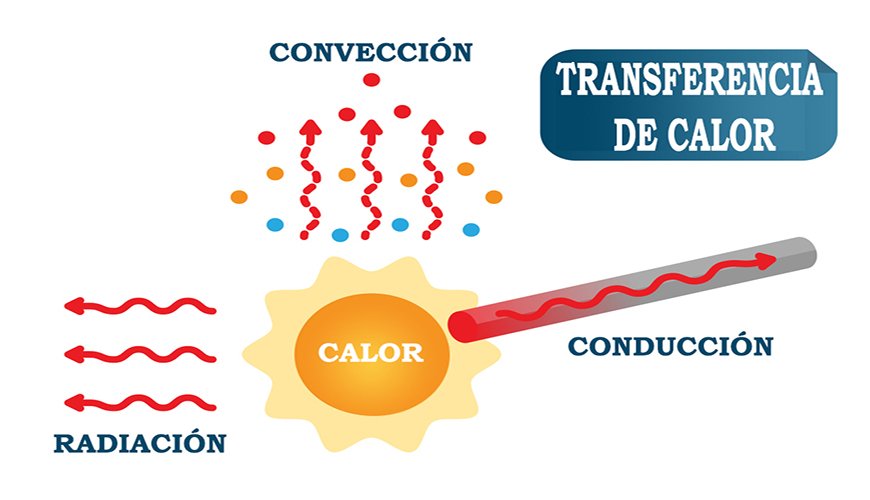
In this case, the transfer occurs by direct contact between two material media and the particles that compose them, and when they are at different temperatures. The state of the materials can be gaseous, liquid or solid and there is no mass transfer between them.
Example: A classic example is heating a metal bar at one end. As there is a temperature differential and there are no external influences or agents, the heat will move (it will lead, as it is conduction) through the bar, from the hottest point to the other.
es: Conducción
Control volume
Noun
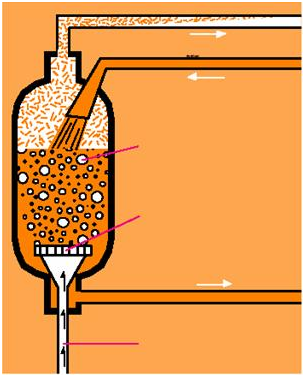
A control volume is a fixed region in space chosen for the thermodynamic study of mass and energy balances for flow systems. The control volume limit can be a real or imaginary envelope.A control volume is a fixed region in space chosen for the thermodynamic study of mass and energy balances for flow systems. The control volume limit can be a real or imaginary envelope.
Example: In this control volumen, any change in the timing of the fluid within a control volume is due to the action of external forces on the fluid within the volume.
es: Control volumen
Convection
Noun
Is the mode of heat transfer between a solid surface and the adjacent liquid or gas that is in motion, and involves the combined effects of conduction and fluid motion and the convection can be forced or natural.
Example: This type of transfer is seen in the heaters: When we bring our hand closer to them we can feel the air currents that are generated by convection, heating the air and decreasing its density for this reason. By reducing its density to a number less than that of air at room temperature, the hot air flows upward.
es: Convección
Emissivity
Noun
Emissivity is the proportion of thermal radiation emitted by a surface or object due to its temperatura.
Example: Fluke Process Instruments sensors have an adjustable emissivity feature to ensure accuracy when measuring other materials such as shiny metals.
es: Emisividad
Energy balance
Noun
It is a relation of the energy that enters and leaves a system, that is to say, it is the study of the energetic changes of a system.
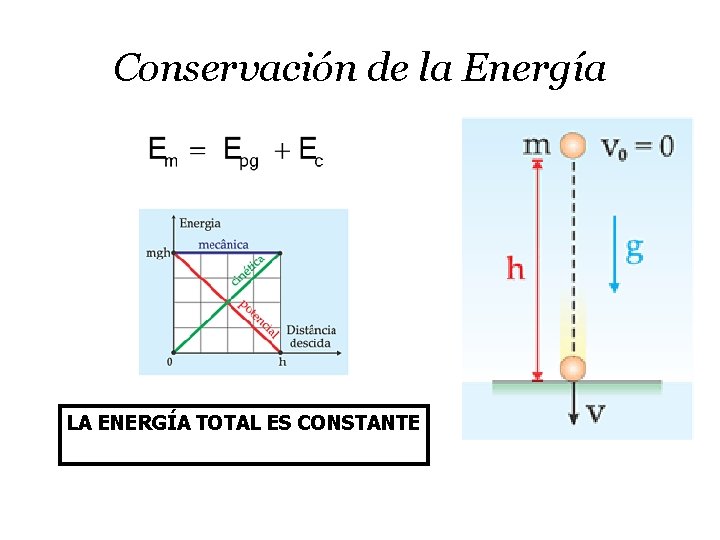
Example: An object that is at a certain height contains potential energy. Releasing it increases its speed as it falls. The maximum speed of the object occurs just before hitting the ground, when the potential energy is zero. That is, at each height, the potential energy that it has lost has been transformed into kinetic energy.
es: Balance de energía
Energy conservation
Noun
It states that the total amount of energy in any isolated physical system (without interaction with any other system) remains unchanged over time, although that energy can be transformed into another form of energy.
Example: As you slide down the slide, on the other hand, your speed increases and so does your kinetic energy, but when you lose height, your gravitational potential energy also decreases. Finally, it reaches maximum speed just at the end of the slide, with its maximum kinetic energy. But its height will have decreased and its gravitational potential energy will be 0 J. One energy is transformed into another, but the sum of both will always yield the same amount in the system described.
es: Conservación de la energía
Heat Transfer
Noun
Is the exchange of the sensible and latent forms of internal energy between two mediums as a result of a temperature difference. Likewise, heat transfer changes the internal energy of both systems involved, according to the first law of Thermodynamics.
Example: It occurs whenever there is a thermal gradient in a system or when two systems with different temperatures come into contact, a red-hot bar transfers heat to the environment mainly by thermal radiation and to a lesser extent by convection.
es: Transferencia de calor
Internal energy
Noun
This type of energy is related to the random and disorderly movement of the particles and has a lot to do with the kinetic and potential energies of a body.
Example: Considering that gases tend to occupy the total volume of the container in which they are contained, since their internal energy will vary as this amount of space is greater and will increase when it is less. Thus, a gas dispersed in a room has less internal energy than if we compress it in a cylinder, since its particles will be forced to interact more closely.
es: Energía interna
Mass transfer
Noun
Mass transfer occurs when a substance is transferred through another or others on a molecular scale. This occurs when two substances with different chemical compositions come into contact.
Example: Some common examples of mass transfer processes are the evaporation of water from a pond into the atmosphere, the purification of the blood in the kidneys and liver, and the distillation of alcohol.
es: Trasferencia de masa
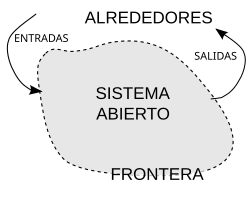
Open system
Noun
It is a system that has external interactions. Said interactions can take the form of information, energy or matter of transfer to the interior or to the exterior of said system, which depends on the discipline in which the concept is defined.
Example: An OPEN SYSTEM contrasts with the concept of a closed system, which does not exchange matter or information with its environment.
es: Sistema abierto
Potential energy
Noun
It is the energy that an object stores and that depends on its position with respect to other objects, or that there is a field of forces within it, in addition to other factors.
Example: The roller coaster's mobile gets its potential energy as it climbs to the top. These peaks function as unstable mechanical equilibrium points. To get to the top first top, the mobile must use the power of its engine. However, once up, the rest of the journey is made thanks to the gravitational potential energy, which can even make it climb to new peaks.
es: Energía potencial
Radiation
Noun
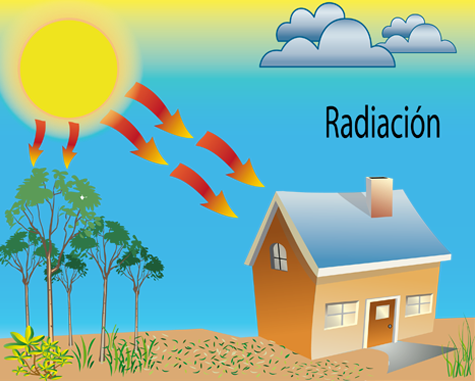
Is the energy emitted by matter in the form of electromagnetic waves (or photons) as a result of the changes in the electronic configurations of the atoms or molecules.
Example: The sun is a perfect example of radiation: Despite being at a great distance, due to its calorific power, it transmits the heat to space that makes the asphalt, despite being far from it, very hot on a summer day.
es: Radiación
Thermodynamics
Noun
Is the branch of physics that studies the effects of changes in temperature, pressure and volume of a physical system (a material, a liquid, a set of bodies, etc.)
Example: Plants convert solar energy (radiant energy) into chemical energy stored in organic molecules.
es: Termodinámica
Total energy
Noun
The total energy of a thermodynamic system can be defined as the sum of each of the types of energies that act in the system since they are the sum of the internal energy plus the potential energy plus the kinetic energy.
Example: Being that Protein counts for 10 15% of TOTAL ENERGY, determining the protein composition in foods is important so that one can use the recommended intake for a group of individuals and help provide a rich source of protein from different foods.